
Why Do Muscles Get Sore?
- by Atsu
- on
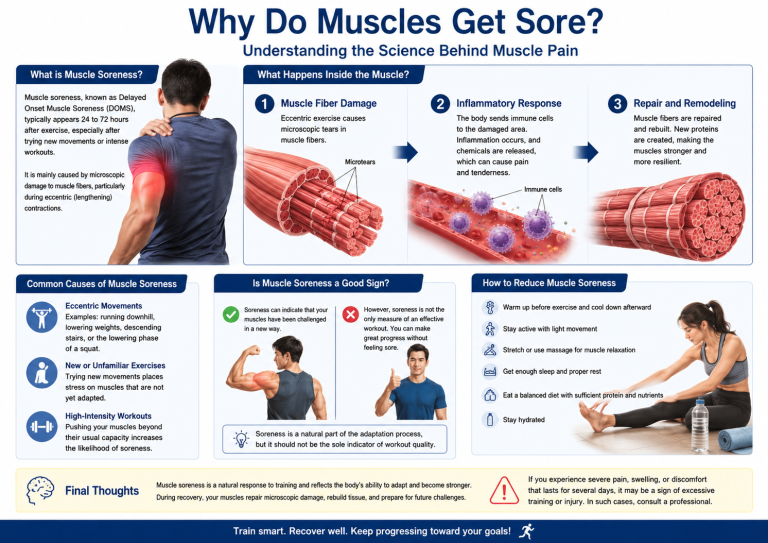
Understanding the Science Behind Muscle Pain
Hello everyone,
Today, let’s talk about a topic that almost everyone who exercises has experienced at some point: muscle soreness.
Have you ever felt sore a day or two after a workout and wondered why it happens? Many people assume that soreness is caused by lactic acid buildup, but modern research has shown that the primary cause is actually a process called Delayed Onset Muscle Soreness (DOMS).
DOMS typically develops between 24 and 72 hours after exercise, particularly when performing unfamiliar movements or high-intensity training. It is most commonly associated with eccentric contractions, which occur when a muscle lengthens while producing force.
Examples of eccentric movements include:
- Running downhill
- Lowering a dumbbell during a bicep curl
- Descending into a squat
- Walking down stairs after a leg workout
During these activities, tiny microscopic tears occur within the muscle fibers. While this may sound alarming, these small amounts of damage are actually a normal part of the adaptation process.
What Happens Inside the Muscle?
When muscle fibers experience microscopic damage, the body immediately begins a repair process.
1. Muscle Fiber Damage
The first stage involves small disruptions to the muscle fibers and surrounding connective tissues. These microtears are a natural response to training stress.
2. Inflammatory Response
Once damage is detected, the immune system sends specialized cells to the affected area. These cells help remove damaged tissue and initiate the healing process.
As part of this response, various chemical substances are released, increasing the sensitivity of local nerve endings. This is one of the main reasons why the muscles feel sore and tender.
3. Repair and Remodeling
After the damaged tissue has been cleared away, the body begins rebuilding the muscle fibers. New proteins are synthesized, and the muscle adapts to better handle similar stress in the future.
This process is what contributes to increased muscle strength, improved resilience, and long-term fitness gains.
Is Muscle Soreness a Good Sign?
Muscle soreness can indicate that your muscles have been challenged in a new way, but it is not the only measure of an effective workout.
You can make excellent progress without experiencing significant soreness, especially as your body becomes accustomed to regular training. Therefore, soreness should not be used as the sole indicator of workout quality.
How Can You Reduce Muscle Soreness?
Although some soreness is normal, there are several strategies that may help reduce discomfort and support recovery:
- Perform a proper warm-up before exercise
- Include a cool-down after training
- Stay physically active with light recovery movements
- Get adequate sleep and rest
- Consume sufficient protein and nutrients
- Stay well hydrated
- Consider gentle stretching or massage
These practices help improve circulation, support tissue repair, and promote overall recovery.
Final Thoughts
Muscle soreness is a natural response to training and reflects the body’s remarkable ability to adapt and become stronger. During recovery, your muscles repair microscopic damage, rebuild tissue, and prepare for future challenges.
While mild soreness is generally normal, severe pain, swelling, or discomfort that persists for an extended period may indicate excessive training load or injury. In such cases, consulting a qualified fitness or healthcare professional is recommended.
Understanding how muscle soreness works can help you train smarter, recover better, and continue progressing toward your fitness goals.
Thank you for reading, and we look forward to sharing more fitness and wellness insights with you in the future.
ANOTHER BLOGS

- Health Tips, Mindset & Motivation
The Human Reset: The Science and Art of Recovery
As science unlocks the secrets of sleep, cellular repair, and the mind-body connection, humanity is beginning to rethink what it truly means to be healthy.
- Priya
- ON

- Health Tips, Mindset & Motivation
Neuro-Cognitive Training: Fitness for the Brain
Train Your Mind, Transform Your Body Fitness is not only about building strength, endurance, or flexibility—it also involves training the brain.
- Priya
- ON

- Health Tips, Mindset & Motivation, Workout Guides
Geometric Alignment: The Foundation of Better Movement
How Movement Shapes Posture and Balance The human body is an interconnected system where alignment, balance, and movement work together.
- Priya
- ON

- Health Tips, Mindset & Motivation
Light Therapy: The Future of Healing; A New Era of Regeneration
When Light Becomes Part of the Healing Process. The future of wellness & healthcare may be brighter than we think. Light therapy is gaining momentum as science uncovers how specific wavelengths can interact with cells and support natural recovery, regeneration and repair.
- Priya
- ON